
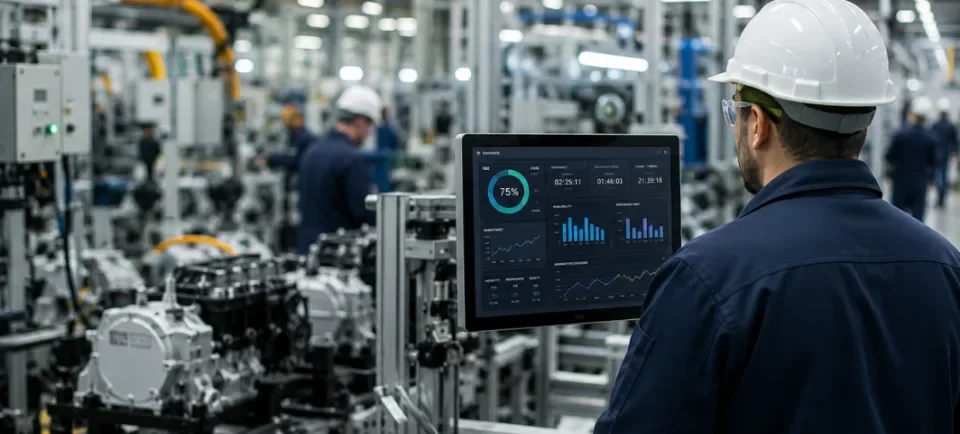
Manufacturing has never had more data.
From production counts and cycle times to downtime tracking and OEE dashboards, modern factories generate a constant stream of metrics designed to measure performance.
But despite all this data, many manufacturing leaders still face the same challenge: they know something is off, but they can’t explain why.
The issue isn’t a lack of data. It’s that traditional manufacturing data doesn’t always capture the full story of what’s actually happening on the factory floor.
The Promise and Limitation of Manufacturing Data
Over the years, manufacturers have invested heavily in systems to track performance:
- MES (Manufacturing Execution Systems)
- PLC and sensor data
- KPI dashboards
- OEE tracking
These tools are essential. They provide visibility into:
- Output levels
- Machine uptime and downtime
- Throughput trends
But most of these systems are designed to answer one question: What happened?
They are far less effective at answering: Why did it happen?
The Gap Between Data and Reality
A production line might show:
- A drop in output
- Increased cycle time
- Lower-than-expected OEE
But those metrics don’t reveal:
- What operators were doing in that moment
- How work was actually performed
- What small disruptions contributed to the outcome
According to Tulip, manufacturing data often lacks the necessary context, such as operator activity, environmental conditions, or process variability, making it difficult to distinguish meaningful issues from normal variation.
Traditional data captures the result, but not the context behind it.
Where Traditional Data Falls Short
1. It Focuses on Machines, Not Work
Most manufacturing data is tied to machines:
- Run time
- Downtime
- Output
But in many environments, especially high-throughput production, human activity plays a critical role.
Data rarely captures:
- Operator movement
- Task execution
- Small delays or hesitation
Without this, a major part of the process remains invisible.
2. It Captures Events, Not Patterns
Traditional systems are good at logging events:
- A machine stopped
- A fault occurred
- A target wasn’t met
But many inefficiencies aren’t single events. They’re patterns that repeat over time:
- Small delays between cycles
- Inconsistent task execution
- Minor variations across shifts
These patterns are difficult to detect without continuous observation.
3. It Lacks Context
A metric might show that cycle time increased.
But it doesn’t explain:
- Was the operator waiting for material?
- Was there confusion about the next step?
- Was the process being performed differently?
Without context, teams are left making assumptions.
And assumptions often lead to:
- Misidentified root causes
- Ineffective improvements
- Repeated issues
4. It Struggles With Root Cause Complexity
Even when manufacturers attempt root cause analysis, the process is often difficult.
Challenges include:
- Poor data quality
- Lack of data integration
- Dependence on expert interpretation
- Bias in identifying causes
Research published on ScienceDirect shows that these limitations can prevent manufacturers from accurately diagnosing production issues and improving system resilience.
Additionally, insights from Databricks highlight that traditional analytical approaches often rely on correlations rather than true causality, leading teams to focus on symptoms instead of underlying causes.
The Result: Data Without Understanding
When data lacks context, pattern recognition, and causal insight, it creates a gap: teams have information but not understanding.
This often leads to:
- Time spent investigating problems without clear answers
- Continuous improvement efforts that don’t stick
- Decisions based on incomplete or biased information
A New Layer of Insight
Manufacturers are beginning to recognize that traditional data needs to be complemented, not replaced.
What’s missing is a layer that answers: What actually happened on the factory floor?
This includes:
- How tasks were performed
- Where time was spent
- How processes varied across operators and shifts
Technologies like computer vision and AI are making this possible by capturing real-world activity and turning it into structured insight.
How Invisible AI Approaches This Problem
At Invisible AI, we focus on bridging the gap between data and understanding.
By analyzing real activity on the factory floor using vision-based AI, manufacturers can:
- See how work is actually performed
- Identify patterns that traditional systems miss
- Understand the true drivers behind performance changes
This doesn’t replace existing systems. It enhances them by providing the missing context.
The result is not just more data, but clear, actionable insight that teams can use to improve operations with confidence.
Closing Thought
Traditional manufacturing data tells you what happened. But to improve performance, you need to understand why it happened.
That missing layer of context is where many of the most important insights live.
If you’re looking to better understand what’s driving performance in your operations, the first step is gaining visibility into how work actually happens, not just how it’s reported.
At Invisible AI, we help manufacturers uncover the hidden patterns across their production lines so they can move faster, improve confidently, and scale what works. Explore how visibility is transforming manufacturing.