
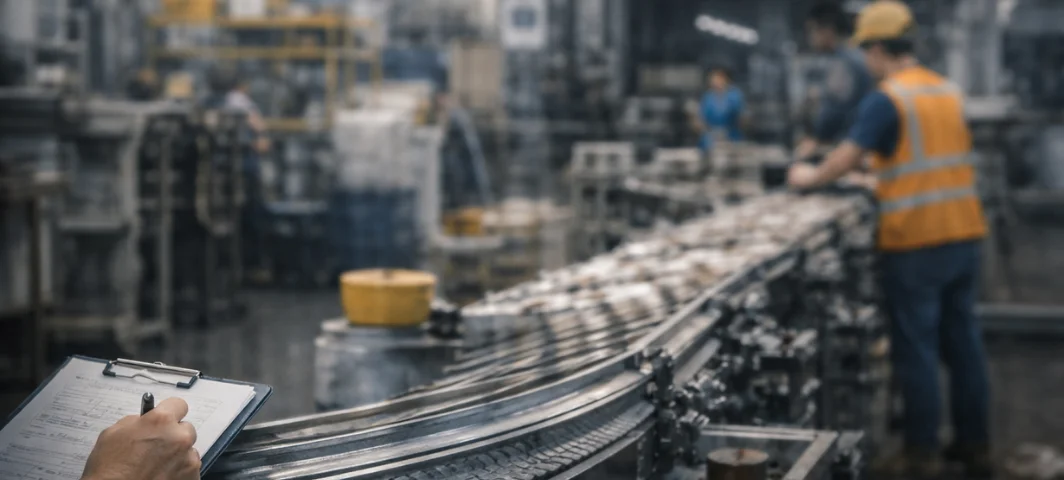
In most manufacturing environments, efficiency isn’t lost all at once.
It disappears slowly—seconds at a time—across dozens of small, almost invisible moments.
A station waits slightly longer than expected. An operator hesitates before the next step. A handoff between processes isn’t as smooth as it should be.
Individually, these moments seem insignificant. But across an entire production line, they add up to something much bigger: lost throughput, missed targets, and hidden cost.
The challenge is that most of these inefficiencies don’t show up clearly in traditional systems or to the human eye.
The Reality of Invisible Efficiency Loss
Manufacturing leaders rely on a mix of:
- KPI dashboards
- Periodic observation
- Operator feedback
These inputs are useful, but they capture outcomes—not the reality of how work is performed.
A line may fall short of its production target, but:
- Where exactly did time get lost?
- How often did it happen?
- What specific actions caused it?
These are much harder questions to answer.
According to McKinsey & Company’s research on manufacturing productivity, a significant portion of productivity loss comes from small inefficiencies embedded in day-to-day operations—not major disruptions.
Where Efficiency Actually Gets Lost
In high-throughput environments, efficiency loss tends to follow patterns that are easy to overlook without continuous visibility.
1. Micro-Delays Between Tasks
Even a 2–3 second delay between cycles can compound across hundreds or thousands of repetitions.
These delays often come from:
- Slight hesitation or uncertainty
- Minor process inconsistencies
- Waiting for parts or tools
They rarely trigger alerts, but they steadily reduce throughput.
2. Line Imbalance Across Stations
When one station runs slightly slower than others, the entire line adjusts around it.
This leads to:
- Upstream buildup
- Downstream idle time
- Inconsistent flow
Because the imbalance is subtle, it often goes unnoticed unless specifically measured. (For more on the fundamentals, see MIT’s overview of production line balancing.)
3. Variability Across Shifts and Operators
The same process can be performed differently depending on:
- The operator
- The shift
- Experience level
Small differences in motion, timing, or sequence can introduce inefficiencies that are difficult to standardize or detect.
This is one of the biggest challenges manufacturers face when trying to scale best practices across lines or facilities.
4. Unstructured or Unobserved Work
Not all work follows a defined process perfectly.
Operators may:
- Search for tools
- Adjust materials
- Work around minor issues
These activities are rarely captured in traditional metrics, but they consume time and affect consistency.
Why These Losses Are So Hard to Detect
The core issue is visibility.
Most manufacturing systems are built to track:
- Output
- Downtime events
- Machine performance
But they don’t capture how work actually happens in real time.
Even direct observation has limits:
- Supervisors can’t be everywhere at once
- Observations are intermittent
- Human interpretation introduces bias
This is the gap many manufacturers are still trying to close.
The Cost of Not Seeing the Problem
Because these inefficiencies are subtle, they often persist unnoticed.
Over time, this leads to:
- Lower-than-expected throughput
- Difficulty hitting production targets
- Ineffective improvement initiatives
- Repeated problem-solving without clear root cause
It also creates a disconnect between what leaders believe is happening and what is actually happening on the factory floor.
This gap is where many continuous improvement efforts stall.
A Shift Toward Continuous Visibility
Manufacturers are starting to recognize that improving efficiency requires more than periodic observation or static data.
It requires:
- Continuous visibility into operations
- Objective understanding of how work is performed
- The ability to identify patterns across time, shifts, and stations
This is where approaches like computer vision and AI are beginning to play a role—not by replacing existing systems, but by adding a layer of operational understanding that hasn’t been accessible before.
How Invisible AI Approaches This Problem
At Invisible AI, we focus on one core idea: you can’t improve what you can’t see.
By using vision-based AI to analyze real activity on the factory floor, manufacturers can:
- Identify where time is actually being lost
- Understand how work varies across operators and shifts
- Pinpoint inefficiencies that traditional systems miss
The goal isn’t more data, it’s clear and actionable insight into how operations truly run.
Closing Thought
Efficiency isn’t lost in obvious breakdowns, it’s lost in the small and repeated moments that are hardest to detect and fix.
The manufacturers that improve fastest are the ones that make those moments visible.
If you’re looking to better understand where efficiency is being lost in your operations, the first step is gaining visibility into how work actually happens, not just how it’s reported.
At Invisible AI, we help manufacturers uncover the hidden patterns across their production lines so they can move faster, improve confidently, and scale what works. Explore how visibility is transforming manufacturing.