
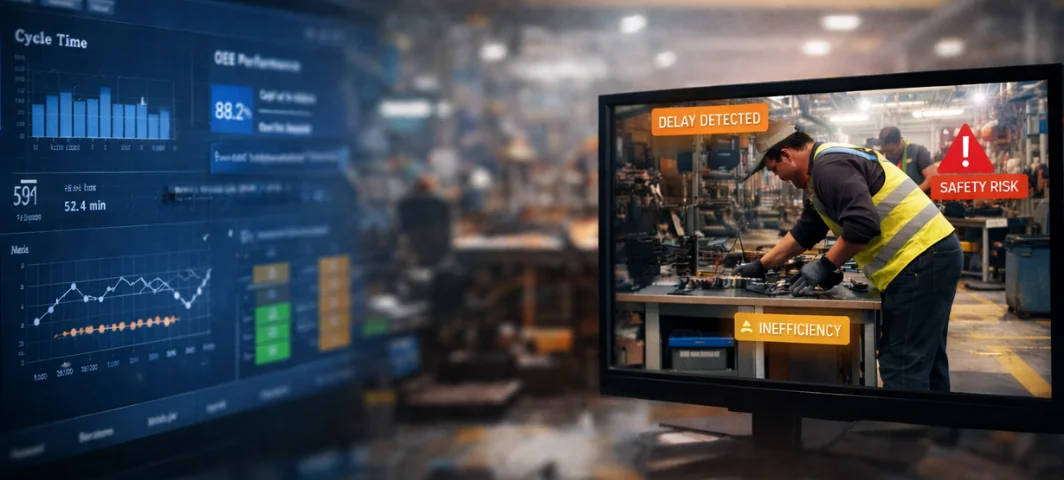
Factories run on numbers. Cycle time. Throughput. Utilization. Downtime.
These metrics are essential but they’re incomplete.
Because what actually happens on the factory floor lives between the data points. And that’s where video changes everything.
Factory video doesn’t replace metrics. It reveals the why behind them. It shows the human behaviors, micro-delays, workarounds, and safety risks that spreadsheets and dashboards simply can’t see.
1. Metrics Tell You What Happened — Video Shows Why
Traditional metrics answer questions like:
- Why did output drop?
- Why did cycle time increase?
- Why is utilization lower on the second shift?
But metrics rarely explain how those outcomes came to be.
Video reveals:
- Operators waiting on upstream processes
- Tools placed just far enough away to create constant micro-waste
- Informal workarounds that keep production moving—but hide systemic issues
What looks like a “performance problem” in the data often turns out to be a process design problem on video.
2. The Hidden Cost of “Invisible” Time
Most factories measure downtime. Very few measure lost time that never registers as downtime.
Video exposes:
- Seconds lost to reaching, walking, and searching
- Repeated pauses for clarification or rework
- Small interruptions that compound into hours per shift
These moments don’t show up in OEE. But they define real productivity.
When teams see this time for the first time, improvement opportunities become obvious and unarguable.
3. Human Behavior Is the Missing Variable
Metrics treat people like variables in a formula. The video shows people as they actually work.
It captures:
- Variability between operators on the same process
- How fatigue affects motion late in a shift
- Where training breaks down in real conditions
- How experienced workers compensate for broken processes
This isn’t about monitoring people, it’s about designing systems that work for humans, not against them.
4. Safety Risks Don’t Always Trigger Incidents
Most safety data is lagging:
- Incidents
- Near misses
- OSHA recordables
Video shows risk before harm occurs:
- Awkward postures that strain over time
- Repeated unsafe reaches
- Congestion zones where collisions almost happen—but don’t (yet)
By the time safety metrics move, the damage is often already done. Video lets teams intervene earlier.
5. Video Creates Alignment Metrics Never Can
Data can be debated. Video can’t.
When operators, engineers, and leaders watch the same footage:
- Assumptions disappear
- Blame turns into problem-solving
- Improvement conversations get grounded in reality
Instead of arguing about whose numbers are right, teams focus on what to fix.
From Measuring Performance to Understanding Work
Metrics will always matter. But they only tell part of the story.
Factory video reveals how work truly happens—moment by moment, motion by motion, decision by decision. And once teams see that reality, better processes, safer work, and higher performance follow naturally.
Because you can’t improve what you don’t fully understand.
Invisible AI uses computer vision to reveal how work actually happens on the factory floor so teams can improve productivity and safety with clarity, not guesswork. See what your metrics are missing.